
Nicole Hardidge, Author at Bellevue Podiatry In Rosanna - Page 11 of 12

Understanding Pediatric Foot Development: A Guide for Parents

Welcome parents, to an educational journey into the interesting world of pediatric foot developmentAs your little adventurers embark on the thrilling path of growth it is crucial to give attention to every aspect of their well being, their tiny feet.

In this blog we will not discuss common concerns related to foot health in children but also provide a wealth of practical advice on promoting holistic and optimal development.

Common Concerns Regarding Pediatric Foot Health

Flat feet in kids

Observing feet in your child might initially raise some concerns but rest assured that this is completely normal during infancy and early childhood.

The arches of their feet tend to develop as they grow.  While it is important to keep an eye on this development, persistent concerns should be addressed by an experienced Podiatry professional to ensure your childs foot health is progressing as expected.

Flat feet are quite common, so concerned parents should not be alarmed.  

Keep an eye on it and get it looked at if it appears to be affeting their movement.

Flat feet in toddlers is nothing to be alarmed about and can be safely assessed by an experienced childrens Podiatrist

Gait Development

The transition from those steps to confident walking is a significant milestone, in a childs life.  Every child progresses at their pace; however it is essential for parents to be mindful of any signs of toe walking or irregular walking patterns.

Early identification of these issues can have an impact, on the health of their feet making intervention even more valuable.  It is always a prudent move to book in for a check-up with an experienced Podiatrist if you notice any movement issues with your child’s developing walking and standing movements.

Choosing The Right Shoes For Kids

Selecting the pair of shoes is like laying a foundation for a building.  It truly matters.  It’s always fun to buy your kids cute footwear but it must provide adequate support.  

Ill fitting shoes can hinder the development of feet underscoring the importance of checking your childs shoe size and timely replacements as they grow.

 An experienced pediatric Podiatrist will be able to give you the right advice so you are completely confident on what shoes you should be buying for your children’s developing feet.

Our Podiatrists can give you the right advice which shoes to buy for your kids, or review shoes you have already bought to confirm thier quality and support.

back to school
Always make sure your children's shoes provide adequate support for their developing feet.

Tips for Promoting Healthy Development of Kids Feet

Encouraging Play

Children naturally gravitate towards activities that are beneficial for their foot development.  Encourage them to engage in play that involves running, jumping and climbing – activities that not bring joy but also contribute significantly to strengthening and flexing those growing feet.

Maintaining a Balanced Diet

Diet plays a role in health and has an impact on developing childrens feet.  Make sure your child enjoys a balanced diet in calcium and vitamin D to promote strong bone growth. Staying hydrated is equally important – water becomes an ally in maintaining the health of those little feet.

Regular Check Ups for Your Childrens Feet

Make foot check ups a part of your childs healthcare routine.  Take note of the condition of your childs feet during stages of development.  Be attentive, to any signs of discomfort or abnormalities. 

It is important to consult a podiatrist in a  timely manner if any concerns arise as they can provide insights and address potential issues promptly.

Addressing Specific Concerns

Ingrown Toenails

Even the tiniest feet can experience problems like ingrown toenails.

As a parent it is crucial to teach your child nail trimming techniques when they are old enough to safely do so and also stay alert for any signs of discomfort.

Make it a habit to regularly check your child’s toenails and keep an eye out for the early signs of an ingrown toenail.

If problems persist seeking help is not only wise but also essential for your childs comfort and overall well being.  Make sure you choose an experienced Podiatrist that is good withh children and makes them feel at ease.

Trim your child's nails so there is only a slight curve across the toenail to reduce likelihood of an ingrown toenail

Choosing Shoes For Developmental Stages

Recognise that infancy, toddlerhood and school age each represent unique stages of development requiring consideration when selecting footwear.  Make sure the shoes your child wears are not fashionable but also suitable for their developmental needs. 

Additionally be prepared for growth spurts that may necessitate adjustments in shoe size.

Being Proactive As A Parent About Their Foot Health

In summary, this blog provides guidance for parents to play a crucial role in promoting the safe & healthy development of their childs feet.  By understanding potential health concerns and fostering habits early on, as a parent you contribute significantly to their overall foot health.

Regular check ups for your childs feet, maintaining a diet and choosing the right shoes all play a crucial role in establishing a strong foundation for your child’s lifelong foot health.

As you begin this journey with your ones remember that their first taking steps now can pave the way for a lifetime of joyful and healthy mobility.  Encourage their playtime keep an eye on the development of their feet and don’t hesitate to seek guidance when necessary.  Here’s to the sound of those little feet resonating through the fabric of their marvelous adventures!

Give your child the right support in living an active life.  Act now and call us today on (03) 9457 2336 or book online and book in to see one of our friendly and experienced Podiatrists.

Does Medicare Cover Podiatry?

Is there a Medicare podiatry covered rebate available for podiatrists?

There are so many disorders for which podiatry is an essential therapeutic choice, including:

  • cases involving persistent pain, such as knee, hip, ankle, leg, or foot pain
  • Arthritic issues
  • chronic disorders like diabetes
  • and issues with the nails and skin

Accessing Medicare reimbursement for podiatry ought to be a straightforward process, but sadly, getting a referral for the Medicare rebate is not always simple.

Depending on the service or doctor you may have spoken to, there is frequently contradicting information about Medicare.  We’ve put up this straightforward guide to help you get through the Medicare system and understand what you might be eligible for if you have no idea where to begin or have never been through the process for podiatry before.

You can gain a better understanding of the podiatry Medicare rebate procedure by reading the following blog.  Let us assist you in understanding the Medicare rebate and how it can apply to your podiatry condition since, once you do, it can be a pretty straightforward process.

Is there a Medicare entitlement available for podiatry services?

Yes, although under some restrictions, is the slightly more complicated response.

Medicare rebates for podiatry come through the chronic disease management pathway. Since 1 July 2025 this has been called a GP Chronic Condition Management Plan, which replaced the older GP Management Plan (GPMP) and Team Care Arrangement (TCA). If a GPMP or TCA was already in place before 1 July 2025, it can still be used until 30 June 2027.

Therefore, who qualifies for a Medicare rebate from a podiatrist?

First, you must satisfy the requirements and condition, which centre on “chronic” diseases or ailments that have lasted, or are expected to last, at least six months.

Second, you must get the proper recommendation document from your doctor, who must schedule a number of appointments for you at our clinic.

ivanhoe podiatrist ivanhoe podiatrist

How many visits will be covered by the Medicare rebate for podiatrists?

Any referred allied health patient may get up to five rebated consultations per year under the chronic disease management pathway – often referred to as a care plan. That might cover speech pathology, dietetics, physiotherapy, podiatry, mental health and more.

Thus, your GP or medical practitioner might recommend that you have two podiatry clinic consultations and three physiotherapy consultations covered by Medicare.  You will require a fresh Medicare recommendation each year, even if this number is reissued annually.

Most organised podiatry patients will contact their doctor in the New Year to set up a Medicare referral, and possible Medicare rebates for the next year, and upcoming appointments after going through the system once over the course of a calendar year.  

What is covered by the Medicare refund for visits to podiatrists?

Regardless of the precise podiatry appointment type you select at the podiatry clinic for your condition, the current Medicare rebate for a consultation is $63.40 (correct at July 2026).

Therefore, the Medicare rebate is $63.40 for the initial podiatry appointment as well as any additional follow-up visits that may be suggested for you known as a care plan.  No matter why you require a podiatry appointment—for nail and skin care, foot pain, or orthotic therapy, for example—the rebate remains the same.

At Bellevue Podiatry we claim the Medicare rebate on the spot and a gap payment applies on top of it. We do not bulk bill. To check the exact out-of-pocket cost for the appointment type you need, call our Reception team on (03) 9457 2336.

What is the procedure for the Medicare refund for my visits?

The Medicare rebate procedure can occasionally be challenging, but we are aware of its challenges and want to make it as simple as possible for you.  At our clinic, you may be asked to partially cover the cost of your consultation using the Medicare refund depending on the appointment type you booked – please speak to our Reception team on (03) 9457 2336 if you would like the exact figures before you book.

Here are the stages in detail:

  1. We obtain the $63.40 Medicare rebate for you by using your Medicare card and swiping it (You avoid having to visit a Medicare office this way).
  2. You can pay the podiatry gap fee using cash, a credit card, or a debit card for your services.

What we have covered in this blog:

  • Yes, you can use the chronic disease management pathway to get a Medicare rebate for podiatry services.
  • You will need a specific GP, human services, health practitioners or health professionals referral and the eligible physical issue.
  • You’ll be eligible for a $63.40 rebate for up to five visits per year.
  • There may be a small gap payment not included in your Medicare rebate.
  • We’ll process the podiatry rebate right away to save you the trouble of visiting a Medicare office.
  • We will be pleased to answer any questions you may have about the Medicare care plan process if you give us a call or send us an email.
  • Alternately, visit your doctor as soon as possible and get a Medicare referral to a podiatrist who can assist you in being pain-free, feeling fantastic, and moving properly.

Diabetic Podiatrists Foot Care “What does a podiatrist do in diabetes?”

What does a podiatrist do with the diabetic foot? Read on for Diabetic Foot Care advice

You may find it surprising to know that nearly every five minutes, a new case of diabetes is identified in a member of the Australian population – that’s just for Australia.  

Of those people that develop diabetes, at least 15% of them, at some point in their lives, will miss the signs and develop a foot ulcer, and 6 percent of those people will end up in the hospital as a result of complications or infections related to their diabetes.  This is a very alarming trend and even more concerning is the fact these figures are growing each year.  A well-educated and trained podiatrist can help in many ways.

Unfortunately, many of individuals with diabetes who require hospital attention will have a condition that will deteriorate to the point where they will require surgical amputation of a toe, foot, or perhaps a limb.  

Hopefully you can now see why those who have diabetes are at a much greater risk of developing foot health issues; hence, it is of the utmost importance for diabetics to take care of their feet and undergo routine foot exams with a podiatrist who is well-trained and highly experienced in dealing with people with diabetes.  We also recommend they check their feet daily – just spending a minute scanning your feet every day can pay huge dividends.  Typically, a well-managed diabetes should not result in a visit to the hospital if the right care plan is in place with a podiatrist.

Diabetes assessment rosanna ivanhoe podiatry Diabetic Foot

What kinds of foot care problems are associated with people who have diabetes?

People who have diabetes are at risk for a variety of potentially very serious foot disorders if they miss the signs are are left unchecked, and podiatrists are not involved in their care:

  • Ulcers: A wound that can arise on the feet or toes, an ulcer is a type of foot injury. When this happens, the tissue that normally covers a portion of the foot or toe perishes and is unable to heal, resulting in an open wound known as ulcers.  Ulcers have the potential to worsen and are prone to serious infection.  The treatments are complex and costly, and if they are not administered correctly, the patient’s damaged limb may have to be amputated due to untreated ulcers.  Even poorly fitting shoes and bad socks can end up in resulting in an ulcer for someone with diabetes.
  • Blood flow issues: People with diabetes typically experienced a decrease in the amount of blood that flows to the feet implies that any wounds or other issues will take longer to recover from.
  • Charcot Foot: This condition occurs in people with diabetes when nerve damage in the feet leads to a weakening of the bones of the foot. When these bones become brittle, they are more likely to break, which can lead to abnormalities in the foot.
  • Nerve damage: this results in discomfort and tingling or numbness in the feet. Reduced nerve sensitivity makes it more likely that a minor injury, such as a cut or blister, may go unnoticed.  Over time, this can lead to more significant issues, including the loss of feeling in the feet and toes.

It is not difficult to comprehend the rationale behind why it is of the utmost significance for diabetics to pay close and consistent attention to the care of their feet with the assistance from a trained podiatrist.  As someone with diabetes, you may not notice if you have any cuts, sores, or other issues since your nerve sensitivity has lessened – but podiatrists will.  Also, because your blood flow has dropped as a result of your diabetes, your body’s ability to repair itself is also affected.

What kind of treatment might diabetic patients receive from podiatrists?

Podiatrists can and should be  an essential member of any health care team that treats diabetic patients.  Our team at Bellevue Podiatry has received specialised training in diabetes foot care and is able to evaluate nerve damage, identify specific diabetic foot health dangers, and assist in the development of a care and prevention strategy for diabetes-related foot issues.  

Those who have diabetes of either type 1 or type 2 should have their feet examined at least once every six months by podiatrists, as this will ensure that any possible conditions are discovered at an early stage.

What process does a Podiatrist follow when doing a diabetes foot health assessment?

The podiatrists will check the circulation to the feet of a diabetic patient by taking their pulse in two different locations: on the top of the foot and on the inside of the ankle as part of their foot assessment.

Establishing a toe pressure for someone with diabetes is another method for determining how much blood is reaching the tips of your feet.  This podiatrist method is analogous to determining the blood pressure in your arm, but instead determines how much blood is reaching your toes. This is a very essential test to determine how well the body can mend itself after it has been injured.

In addition to this, the podiatrists will examine the degree to which the nerve endings in the foot are sensitive.

In order to accomplish this, we first have the patient close their eyes, and then the podiatrist will question them about the various feelings they are experiencing.  If there is any cause for worry regarding decreased blood flow or nerve injury, a primary care physician will be alerted, and additional ultrasounds will be required for further investigation.

There are over 4000 diabetic-related amputations performed annually in Australia, with the vast majority of these being performed on the toes or feet.  The harsh reality is that early intervention has the potential to prevent 80% of these amputations from occurring.  

Throughout the northeast Melbourne metro area, the team at Bellevue Podiatry have the education and experience to assess and protect diabetic feet from unnecessary complications that could have been avoided with early intervention.  

If you have been diagnosed with diabetes, have a possible wound infection, loss of nerve sensitivity or are just interested in getting a foot health assessment please call us on (03) 9457 2336 or book online so we can get you peace of mind and start working with you to protect your feet long term.

What conditions can podiatrists treat?

What Conditions Can Podiatrist Treat? Common Podiatry Problems

The human foot is a complex, mechanical structure made up of over 100 tendons, muscles, and ligaments, 26 bones, 33 joints, and other supporting structures.  Daily pressure is constant on the feet, and with so much use and complexity, it is no surprise there is a wide range of potential health issues one can experience with their feet, ankles and lower limbs.

With so many working parts, this complex and highly developed structure requires some maintenance and health care on a regular basis. Planned and regular visits to the podiatrist are a wise investment in the strength and health of your feet in the long run. It is always better to prevent a problem before it takes hold on your health.  The longer you ignore an issue, the longer and more complex the podiatrist health treatment will likely be to resolve it.

This blog gives an overview of the ten most frequent causes of foot and ankle podiatrist conditions we see on a weekly basis at Bellevue Podiatry.  There many more conditions treated by podiatrists – this list is just a subset of the most common problems.  If you have any concerns about your foot health, please don’t hesitate to give us a call on (03) 9457 2336 to speak with one of our friendly Podiatrists.

Please click on each of the below headings to learn more about each of the foot or ankle podiatrist health conditions and disorders.

Heel pain and Plantar Fasciitis conditions can have such a negative impact on the quality of someone’s health and life – it can stop them from going to the gym, running around with the kids, and even dread taking those first few steps in the morning.  The good news is that it doesn’t have to be this way.

The Podiatrists at Bellevue Podiatry help people like you treat and eliminate heel pain and plantar fasciitis every day.  Adults, teenagers, and even children can experience acute or chronic pain in the heel and along the plantar fascia in their foot.  What usually begins as a minor pain gradually worsens over a number of years until it is unbearable.

ivanhoe podiatrist ivanhoe podiatrist

Nearly every one of us has had a wart at some time in our lives.  One of the most common podiatry conditions that we treat, many of us pick up as children at swimming pools or in communal areas.  They spread through families, particularly because many of us are barefoot around the house and use the same shower.  Many warts spontaneously disappear within two years but many also go on to be a persistent problem and can even spread to other areas of the foot and body.  This is why it’s important to see a podiatrist.

Callus and corns are usually a sign that there is too much pressure and friction going through that area of your foot.  If you have callus on the top of your toes its usually a sign that your shoes are too shallow.  Or you may have callus under the big toe joint, this usually indicates that this joint is not working effectively when you are walking and is being overloaded.  The good news is podiatrists specialise in treating corns & calluses, so don’t put them on your feet any longer.

Bunions can create a significant impact on the quality of your life – just putting on your favourite pair of shoes can be a painful task.  But it doesn’t have to be this way, bunions are one of the most common conditions podiatrists treat in the foot.  There are effective treatments available to resolve your painful bunions and get you walking pain free again.

Although not the only cause of bunions, it is a well established fact that the shoes we wear in the Western world are one of the major causes of bunions.  Did you know that bunions effect around 30% of the population in Western countries, but only effect 3% of the population in Eastern countries?  The reason for this significant difference is the shoes we wear in Western countries such as high heels or trendy loafers or boots that have a narrow toe box.

bunion forming podiatrists near

Ingrown toenails are one of the most common and annoying of the podiatry conditions we treat.  Even shoes and the weight of bed sheets can cause irritation that interferes with your day-to-day activities and quality of life.  A minor ingrown toenail in your foot can turn in to an infection that, if left untreated, could become quite serious – but the good news is ingrown nails are readily treatable, you don’t need to put with them any longer when you see a podiatrist.

Fungal toenails can and does stop someone from going to the beach or swimming pool if they feel self-conscious about showing their feet in public.  Ironically, even going to a Yoga class can be source of frustration when you have fungal toenails.

We see fungal toenails, or onychomycosis, several times a week in our clinic – it can effect one foo or spread to both feet.  An infected toenail may be thick, crumble when trimmed, and appear white, yellow, brown, or greenish.  Alternatively, some fungal infections leave a white, powdery substance on the toenail plate.  Toenail fungus infections are believed to effect up to 12% of the world’s population – it is a common problem that effects a lot of people.

ivanhoe podiatry

Do you feel pain around the back of your ankle and heel area when taking your first steps in the morning?  You may have Achilles Tendonitis, a very common but readily treatable condition.

Achilles Tendonitis can affect people from all walks of life.  People with Achilles Tendonitis usually find it only affects one leg and will usually feel a sharp pain when the Achilles Tendon is pinched by a Podiatrist testing for this condition.

Most people also find that the pain reduces once the Achilles Tendon is warmed up with increased blood flow after a period of rest (i.e. the first steps in the morning are quite painful, but dissipate somewhat after five minutes of movement).

Do you get a sharp pain just behind your toes that worsens when you stand, run or walk?  Ball of Foot pain is more common than you think and the good news is that it is readily treatable. 

There are a lot of structures (joints, muscles, bones, nerves etc) in the ball of the foot that can become painful when put under stress, so Ball of Foot pain is a common conditions that we see often in our Clinic.  Metatarsalagia is often an umbrella term used to diagnose pain on the ball of foot, but usually there is a specific part of the foot that is being stressed that needs to be addressed through a tailored treatment plan based on the needs and behaviours of each individual.

You may be wondering what that dry, itchy skin is on your foot or what the tiny little blisters are on your foot – it’s likely Tinea or as it is otherwise known, Athlete foot. 

Not all tinea appears in between the toes as cracked or wet.  Tinea is a fungal infection of the skin of the foot, usually caused by dermatophytes (fungus), that can be anywhere from mildly irritating to very painful.  It’s important to get Tinea treated before it becomes a serious problem that spreads across your foot or gets under your toenail and becomes a fungal toenail infection

Shin splints, or medial tibial stress syndrome, can be described as shinbone pain that occurs anywhere along the front of the bone.  It is commonly thought that shin splints are tiny fractures along the inside of the bone; however, this is not the case.  A sudden increase in activity causes excessive traction from muscles that attach to the lower leg, resulting in inflammation and pain.

Having shin splints can stop you from exercising and it can even hurt to walk – podiatrists can help you with these conditions and treat them effectively.  Shin splints are very frustrating and can stop you doing the things you enjoy in life, but the good news is you don’t need to put up with them any longer.

prevent blisters

Podiatrists treat many problems & conditions for feet and ankles

The above list is just a sample of the various issues that a Podiatrist has the training and experience to remedy.  At Bellevue Podiatry we know that ignoring a problem never cures it, and the longer you leave it the more likely it require a more complex treatment plan. 

If you have any foot or ankle concerns, we recommend you seek professional advice sooner rather than later.  Please call our Reception on (03)9457 2336 or book online for an appointment if you have any foot or ankle concerns.

Understanding Achilles Tendonitis and Its Treatment Options

Understanding Achilles Tendonitis and Its Treatment Options

Being physically active is crucial for maintaining good health, physical fitness, and preventing chronic diseases like diabetes and heart disease. However, both professional and amateur athletes (and weekend warriors) who have tendon injuries may experience excruciating pain that makes them less active. Achilles tendonitis is one of the more prevalent disorders affecting tendons in our society today, and the latest data shows it is becoming more common.

Acilles Tendonitis: What is it?

Tendons transfer forces from muscles to bone so that we can move. They are composed of well organised, perfectly aligned collagen fibres, which give them their extraordinary strength. In actuality, when jogging, the Achilles tendon can carry up to 12 times its own weight. The term “tendinosis” (sometimes known as “tendinopathy”) refers to deteriorating changes in the tendon structure.

Achilles tendonitis

Why Does Achilles Tendonitis Occur?

Running or other sports that require a lot of running frequently result in Achilles tendonitis because the tendon is subjected to increasing loads. This is due to the fact that the Achilles tendon joins the calf muscles to the heel bone to enable the push off necessary for running. The tendon’s midsection is where the Achilles tendonitis usually manifests, however it can also damage the area where the tendon attaches to the bone.

The majority of the time, tendons react well to consistent loading (i.e., the length and intensity of running), but they detest sudden shifts in load. As a result, the tendon structure becomes disorganised and ineffective because it is unable to support the increasing load. For instance, a person who hasn’t run in three months decides to run 30 km per week.

Age, weak calf muscles, ankle instability, and flat feet are additional risk factors for the development of Achilles tendinopathy.

Achilles Tendonitis symptoms

Achilles tendonitis is characterised by:

  • Pain when the tendon is loaded, such as during running
  • Morning stiffness in the tendon, which usually goes away as the tendon warms up;
  • Achilles tendon swelling; and
  • Reduced strength or power because of the pain.

Achilles tendonitis treatment

Tendons prefer to be consistently loaded within their limits. Therefore, appropriate loading exercises serve as the cornerstone of treatment for Achilles tendinopathy.

As overload is frequently the problem, this frequently entails initially limiting activity and gradually increasing this capacity over the ensuing weeks. Anti-inflammatory drugs and ice are other early-stage adjuncts, however they only offer temporary relief.

The Achilles tendon can then be helped by adding calf-strengthening workouts afterwards. Correction of biomechanics may also be necessary in the case of someone who has persistent ankle instability, as the right footwear can help to unload the tendon and reduce discomfort.

However, it should be remembered that even with the best treatments, this is a condition that can take months to completely treat. The safe road back to strong Acilles tendons should be a patient and planned one.

For a precise diagnosis, it’s important to contact a podiatrist because symptoms of other diseases like bursitis or nerve entrapment can resemble those of Achilles tendinopathy. Additionally, a podiatrist can offer the right exercises and tools, such orthotics, to assist manage the issue.

It’s crucial to seek professional assistance if you have Achilles tendonitis or any other foot or ankle ailment. Our team of professionals at Bellevue Podiatry is committed to you the best treatment for all of your foot and ankle health issues.

You don’t need to put up with Achilles Tendonitis any longer.  Our team of experienced Podiatrists have the education and experience to get you moving pain free again.  Take control today by booking in online or call us today on (03) 9000 0418 to get this issue sorted once and for all.

Morton’s Neuroma:  Causes, Symptoms, and Treatment

Morton’s Neuroma:  Causes, Symptoms, and Treatment

Do you get the feeling like your sock is folded over or there’s a pebble in your shoe, only to find nothing there?  Does the ball of your foot sometimes hurt with a sharp, burning pain going into the toes?  You could have something called Morton’s neuroma.  It’s a common foot condition that affects 1 in 3 people.1


What is a Morton’s neuroma?

Morton’s neuroma is a painful condition of the ball of your foot.  The term neuroma means a benign (non-cancerous) nerve tumour.  However, Morton’s neuroma is not really a tumour.  Rather, it is a thickening of the tissue surrounding the nerve that goes into your toes.

Morton’s neuroma most commonly occurs between the third and fourth toes because space here is narrower compared to the other spaces between the toes.The symptoms are usually present on one side.  Rarely, both feet may be affected.2

 Both men and women can develop Morton’s neuroma, but it is up to 10 times more common in women compared to men.3
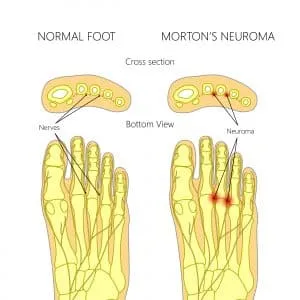
What does a Morton’s neuroma look like? What does it feel like?

When you look at the underside of your toes, you may not see or even feel anything.  That’s because Morton’s neuroma is not actually a tumour.  The most common Morton’s neuroma symptoms include:2,4

  • The sensation of a lump or feeling like there’s a marble in your shoe.
  • Sharp, burning pain in the ball of your foot.
  • Stinging, burning, or numbness in the toes.
  • Pain between the toes that is aggravated by walking or wearing tight-fitting, high-heeled footwear and relieved by taking off the footwear and resting.


Why did I get a Morton’s neuroma?

A Morton’s neuroma develops due to pressure, irritation, or injury to the nerves that go into your toes. Some of the risk factors for Morton’s neuroma are:4

  • Wearing high-heeled, narrow toe box, or ill-fitting shoes that put pressure on the ball of your foot.
  • Wearing tight shoes for sports like rock climbing or skiing that put pressure on your toes.
  • Participating in high-impact sports like running that cause repetitive trauma to the foot.
  • Foot deformities like bunions, flat feet, high arches, and hammertoes are risk factors for Morton’s neuroma.

How is Morton’s neuroma diagnosed?

There is no specific Morton’s neuroma test.  We diagnose the condition based on your history and physical examination.  Sometimes, we may inject a local anaesthetic into the area to see if it helps.We may also get X-rays to rule out other causes of your symptoms, such as a stress fracture, foot deformities, or arthritis.  A Morton’s neuroma ultrasound may be ordered to aid diagnosis.  An MRI is sometimes needed to rule out other conditions.

Does Morton’s neuroma go away?

A Morton’s neuroma does not disappear on its own.  However, your symptoms may come and go depending on the type of shoes you’re wearing and how much time you’re spending on your feet.5

What happens if Morton’s neuroma goes untreated?  It’s difficult to say.  Your symptoms could get better or go away completely.  They could also get worse, causing you to limp or forcing you off your feet.  Our recommendation is it’s best not to ignore foot pain that lasts more than a few days.

What is the best treatment for Morton’s neuroma?

Morton’s neuroma treatment includes one or more of the following:5

  • Wearing low-heeled, wide-toed, comfortable footwear with good arch support.
  • Cutting back on high-impact activities like running and dancing.
  • Metatarsal pads or crest pads to provide cushioning.
  • Orthotics (shoe inserts) to correct mechanical imbalances that may be putting pressure on the area.
  • Anti-inflammatory medications and icing for symptom relief.
  • Injection of anaesthetic and steroid medication into the area.
  • Morton’s neuroma exercises to stretch and strengthen the foot.

In severe cases, where symptoms do not get better with conservative treatments, it may be necessary to perform surgery for Morton’s neuroma.  The surgeon will either remove the nerve or cut away nearby structures to relieve pressure on the nerve.4

How long does it take to recover from Morton’s neuroma?  If you have surgery, you may need to be on crutches for about 3 weeks.  Complete recovery can take up to 6 weeks.

The most important thing you can do to prevent Morton’s neuroma is to wear properly fitted, comfortable shoes as far as possible. If you already have symptoms and suspect your foot pain is due to Morton’s neuroma, you should get it checked out. Please give our Reception a call on (03) 9457 2336 and book an appointment.  We’ll be happy to examine you and treat your Morton’s neuroma if needed.

References:

  1. Cleveland Clinic. Morton’s Neuroma. [Internet] Accessed on December 9, 2020. Available from: https://my.clevelandclinic.org/health/diseases/15118-mortons-neuroma
  2. Munir U, Tafti D, Morgan S. Morton Neuroma. [Updated 2020 Jun 2]. In: StatPearls [Internet]. Treasure Island (FL): StatPearls Publishing; 2020 Jan-. Available from: https://www.ncbi.nlm.nih.gov/books/NBK470249/
  3. Ortho Info. Morton’s Neuroma. [Internet] Accessed on December 9, 2020. Available from: https://orthoinfo.aaos.org/en/diseases–conditions/mortons-neuroma
  4. Mayo Clinic. Morton’s Neuroma. [Internet] Accessed on December 9, 2020. Available from: https://www.mayoclinic.org/diseases-conditions/mortons-neuroma/symptoms-causes/syc-20351935#
  5. Harvard Health Publishing. Morton’s Neuroma. [Internet] Accessed on December 9, 2020. Available from: https://www.health.harvard.edu/a_to_z/mortons-neuroma-a-to-z#

I think I have a bunion forming, what can I do about it?

Have you recently (or not so recently) noticed a bump forming on the side of your foot where your big toe starts?  Does it now hurt to walk or is the bump red and painful to touch?  You could have the start of a bunion, a common (but sometimes painful) issue that effects over a quarter of the Australian population (over a third of the population if you are 65 or older).

What do bunions look and feel like?
First off, let’s be clear on what a bunion and what it looks & feels like so you can be sure if you have this common ailment. Symptoms of bunions tend to increase over time as the condition worsens, typical symptoms include:

  • Deformity of the big toe joint
  • Growth of a bony lump at the side of the big toe joint
  • Pain, redness and tissue swelling over the big toe joint, with thickening of overlying skin
  • Pain when walking (particularly during the “push off” phase)

People with advanced bunions can sometimes be so pronounced that the big toe overlaps or underlays the second toe.  Advanced cases like these can be very painful and debilitating, which is why it is very important to seek professional guidance now if you look to have the early stages of a bunion forming.  Treatments can be implemented in the early stages to slow down the progression of a bunion.

How did I get a bunion?
Some people are more susceptible to bunions than others due to the structure of the bones in their feet. This has been demonstrated consistently over time with some families having a problem with bunions, while other families don’t. In other words, your genetics play an important role in whether you will get a bunion… however that isn’t the only reason and there are things you can do (i.e. your behaviour and habits) to lessen the chances of getting a bunion.

Fun police warning: wearing shoes such as high heels and / or pointed toe shoes will increase your chances of getting a bunion, particularly if you wear them all day, every day.

Other factors that are known to increase the risk of bunions include:

  • Certain arthritic conditions and ligament disorders
  • Age (the incidence of bunions increases with age)
  • Being flat footed with feet that roll inwards
  • Past injury (trauma) to the foot

I am now sure I have a bunion forming, what can I do to slow and stop its growth?
The most important thing to do when treating a bunion is to reduce the pressure that has been placed on the bunion that created it in the first place.  There’s not much you can do about changing your genetics but certainly addressing the underlying reason you have the bunion (poorly fitted footwear, flexible flat foot) can have a positive impact in slowing down the growth of your bunion.  Wearing properly fitted and appropriate footwear is a must.

From there, a detailed biomechanical assessment of your foot and walking style would be conducted to understand whether a need for special orthotic devices is required, such as custom-made arch supports or shoe inserts.  These devices can help to relieve tension on the big toe and help prevent flat footedness. It will also be important to prescribe an exercise program to strengthen your foot muscles for correct form and function to further assist in bringing the toe joint back into alignment.

In severe cases, if a sufficient reduction in symptoms is not achieved by non-surgical treatment, then surgery may be recommended by your Podiatrist.

The most important thing you can do now to stop your bunions getting worse, and avoid the possibility of surgery, is to wear properly fitted shoes as much as possible.  You may not look as good when going to work, or hitting the town, but it will be worth it in the long run.  If you think you have a bunion forming and would like to get more detail on the treatment options discussed here, please give our Reception a call on (03) 9457 2336.  It is important to get expert advice as early as possible when treating bunions, so don’t hesitate to give us a call if you have any concerns.

Looking after your feet in Stage 4 restrictions

Unless you are one of the relatively few permitted workers that can still go into work, the rest of Melbourne is essentially house bound until the Stage 4 COVD-19 restrictions are lifted. Literally millions of Melburnians are now spending the clear majority of their time indoors and around the house.

What does this mean for Melbourne’s feet?
Whether you are working from home, or just stuck at home, it is quite likely the average Melburnian is not wearing supportive footwear like they used to when they left the house pre-COVID (which feels like a life time ago now).

It’s safe to assume the number of people wearing slippers and Ugg boots, and the duration they are wearing them, would have sky rocketed over the past six months since COVID-19 reached our shores. If you own shares in a company that makes slippers, the lockdown is not all bad news, however the lockdown is not good news for your feet. Slippers are not designed to worn all day every day, and that kind of usage brings with it potential foot health problems you’ll need to watch out for.

It’s not a good idea to wear my trusty, super comfy slippers all day??
Firstly, consider the purpose of your common slipper or Ugg boot. They are designed to keep your feet nice and warm first thing in the morning, or late at night as you are winding down for bed. Slippers and Ugg boots have the following characteristics:

  • Zero support for your feet and arches
  • Are loose fitting and packed with faux-fur
  • Offer virtually no grip on their soles
  • Have even less cushioning for absorbing impact

They are built for comfort and warmth, and not much else. Consider what this means for someone’s feet when they are now wearing slippers up to 16 hours a day…

Wearing slippers and Ugg boots all day could cause foot health issues
With slippers and Ugg boots becoming the first choice in foot wear during the lockdown, people may start to experience the following issues:

  • Foot pain – constantly wearing slippers that offer no support can place increased pressure on the arches of your foot (this pain can also refer to your ankles, knees, hips and even lower back)
  • Tinea / fungal nail – Fungal infections thrives in the warm and sweaty conditions of constantly worn slippers, the perfect place for an infection to start and spread like wild fire
  • Bacterial infections – Bacteria, like fungi, love moist and warm environments.  Skin conditions like pitted keratolysis can cause pits to form in the skin and lead to smelly feet. So if your feet are a bit on the nose, check underneath your foot.
  • Slips and falls – slippers and Ugg boots are loose fitting and offer very little grip, especially if you are walking around on tiles, so slips, trips and falls are more likely (more so people over the age of 70)

Ok, I get it, don’t go overboard on wearing my slippers… so what do I wear on my feet instead?
It looks like Jerry Seinfeld may have been onto something with wearing a quality pair of sneakers around the house as they offer great support for your arches and fit snugly around the rest of the foot.

Also, we recommend you check out your current pair of slippers to see if the sole is worn down and / or the faux-fur cushioning on the inside is starting to smell. Slippers and Ugg boots weren’t designed to be worn up to 16 hours a day and it might be time to throw them out and get another pair that you wear sparingly around the house. Be sure to review your feet about once a week to check their appearance for any infections or changes in your skin.

If you have any questions about slippers and foot health, please feel free to give us a call on (03) 9457 2336 and ask to speak to one of our experienced Podiatrists.

The Importance of Foot Strength

The Importance of Foot Strengthening to Reduce Falls

As we get older, something that is important to start considering is our increased risk of falling and injuring ourselves.  It is a frightening fact that the chance of falling becomes much higher as we age.  In fact, one third of people over sixty-five and half of people over the age of eighty-five will fall every year.

While that may be an alarming statistic, the good news is that you can significantly reduce the risk of falling through foot strengthening exercises and choosing the correct footwear.

The muscles in our feet are critical in saving ourselves from falling.  These muscles weaken over our lifetime, so they require a simple strengthening program tailored to your feet to keep them doing their job as best they can.  It takes just a three percent increase in toe strength to reduce your risk of falling by twenty percent.

At Bellevue Podiatry, we use a specifically designed platform called the ‘ToePro’ (find out more at www.mytoepro.com.au) to strengthen the foot muscles.  This platform places the foot in a position that the muscles would be used to in walking, which strengthens the muscles four times faster than doing exercises with the foot flat on the ground.  Our podiatrists are all trained to use the ToePro and will tailor a program specifically to your needs.  This strengthening can start to show results in a matter of weeks.

Another very important factor in avoiding falls in older people is footwear.  The wrong choice of shoes can drastically increase your chances of falling.  When choosing footwear to avoid falls, we know that a range of features in a shoe are crucial.  Here are some important things to remember:

  • The heel base should be wide; narrow or very tapering heels reduce stability.
  • The base of the shoe should have grip to it; try to avoid shoes with smooth, slippery soles.
  • The shoes should always have either laces or a strap.
  • The heel counter, the part of the shoe that wraps around the back of the heel, should be firm and not easily squashed with your thumb.
  • Avoid wearing slippers, socks, or bare feet at home all day as this increases your chance of falling by up to 50%. If you can, keep a pair of shoes (that incorporate the features listed above) to wear around the house.

Following this simple advice can help you stay active and enjoying life!  If you have any questions about what you have read here and would like to know more, please give us a call on (03) 9457 2336 to discuss further.