Effective Removal of Ingrown Nail: Your Comprehensive Guide to Treatment and Prevention | Toenail Surgery Podiatrist

Blog 140 – Effective Removal of Ingrown Nail: Your Comprehensive Guide to Treatment & Prevention

You’ve likely felt the sharp pain of an ingrown toenail digging into your skin, causing swelling and discomfort that hinders your steps. Don’t attempt removal yourself—it risks infection and recurrence.

Instead, start with proven home care, but know when professional intervention becomes essential. Please read on, where we discuss the safest paths to relief and lasting prevention.

Key Takeaways

Understanding Ingrown Toenails

An ingrown toenail occurs when the edge of a toenail grows into the surrounding skin. This can cause pain, redness, swelling, and potentially infection. It most commonly affects the big toe but can occur on any toe.

An ingrown toenail develops when the nail’s edges grow into the surrounding skin, often affecting your big toe and representing about 20% of foot issues seen in primary care, especially among young men:

These early, prompt treatment prevents complications like follicle hypertrophy and severe infection.

Why DIY "Removal of Ingrown Nails" Is Not Recommended

Ouch! Does your big toe look like this? You may be tempted to try and "fix" your ingrown toenail at home, but the reality is the vast majority of our patients that attempt At Home DIY end up making things worse - which makes our job harder and more complex. Early professional intervention is always the smart choice.

Why tackle an ingrown toenail yourself when it often leads to serious complications?

Professionals provide sterile environments and expertise, avoiding contraindications like unsafe chemical procedures in pregnancy.

Initial Home Care and Self-Treatment Strategies

Before seeking professional help, you can some try initial home care strategies to ease ingrown toenail discomfort and prevent worsening – we recommend you only consider these at home remedies if your ingrown toenail is in the very early stages.

For ingrown toenails, which often affect your big toe, you can manage mild cases at home. Start with warm salt water soaks to soften the toenail and reduce swelling on your foot. If symptoms persist or worsen, don’t delay consulting a professional.

A foot soak in warm, salty water can help relieve pain and discomfort from an ingrown toenail - however we would only suggest this home remedy for early onset and mild ingrown toenail cases.

Professional "Removal of Ingrown Nail" Procedures

When conservative home treatments fail to resolve your ingrown toenail, professional medical intervention becomes necessary to prevent complications and provide definitive relief.

Your healthcare provider will assess the severity of your condition to determine whether non-surgical medical treatments or surgical interventions offer the most appropriate therapeutic approach.

The choice between these professional removal procedures depends on factors including the presence of infection, recurrence history, and the extent of nail embedment in surrounding tissue.

Non-Surgical Medical Treatments

When you’re experiencing mild to moderate ingrown nail symptoms, several non-surgical professional treatments can effectively resolve the condition without requiring invasive procedures.

The following evidence-based interventions offer significant pain relief and correction while preserving nail integrity and minimising recovery time.

Professional Nail Trimming

Professional nail trimming serves as the primary non-surgical intervention for ingrown toenails, where a podiatrist carefully excises the problematic nail edge using specialised instruments to eliminate pressure against surrounding tissue.

This first-line treatment involves removing the ingrowing portion through precise cutting techniques.

Your podiatrist will address ingrown nails by strategically trimming affected areas to prevent further complications.

Nail trimming and debridement from a professional can be an effective measure against some cases of ingrown toenails.

The BS Brace is a modern treatment that helps guide the growth of problematic nails using gentle pressure, so there’s no need to cut away any tissue, while also tackling the root causes of ingrown nails.

Our podiatry specialist will conduct a thorough assessment before applying this specialised brace to your affected toenail, offering superior outcomes compared to partial nail removal procedures.

Similar to the BS Brace’s mechanical approach, Onyfix employs composite resin technology to correct ingrown toenail trajectories without surgical intervention.

This LED-cured treatment reshapes nail growth patterns, eliminating the need for ingrown toenail surgery or ingrown toenail procedures.

A professional application ensures precise positioning for ideal ingrown toenail removal outcomes.

You’ll avoid anaesthesia while achieving effective correction of ingrown toenail surgery candidates through this non-invasive alternative.

Over time, the OnyFix brace grows out with your toenail and "trains" it back into correct position safely and painlessly.

Surgical Interventions for Ingrown Toenails

When conservative treatments fail to resolve your ingrown toenail, surgical interventions offer definitive solutions with high success rates.

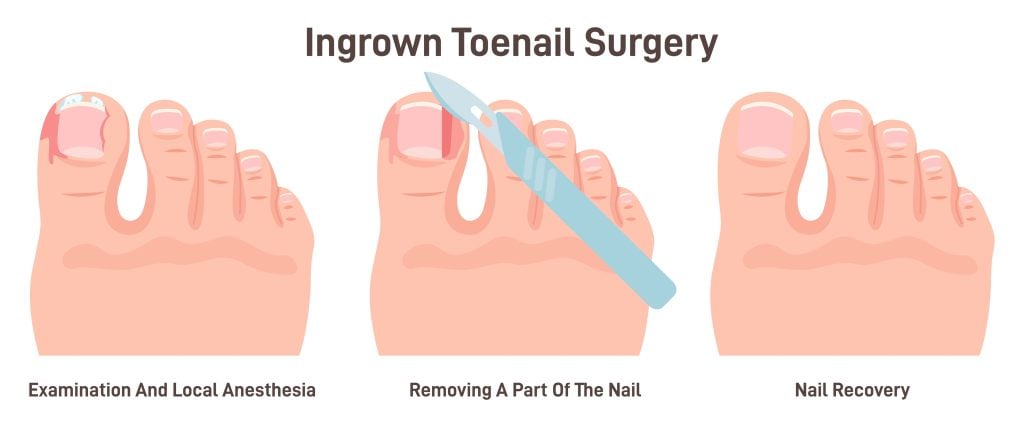
You’ll typically undergo partial nail avulsion (PNA) for localised ingrowth or total nail avulsion (TNA) for extensive involvement, both performed under local anesthesia.

Your podiatrist may combine these procedures with phenolization or other matrix destruction methods to prevent nail regrowth and reduce recurrence rates to as low as 1.1%.

Partial Nail Avulsion (PNA)

Partial nail avulsion (PNA) represents a definitive surgical intervention for moderate to severe ingrown toenails that haven’t responded to conservative treatment.

This surgical procedure for ingrown toenails involves ingrown toenail extraction under local anaesthetic, removing approximately 30% of the lateral nail plate.

The toenail removal procedure utilises specialised instruments and demonstrates superior efficacy when combined with phenolization.

A partial nail avulsion is a minor surgical procedure where a portion of an ingrown toenail is removed to relieve pain and prevent regrowth. It's often performed under local anesthetic, and a chemical may be applied to the nail matrix to prevent the affected portion from growing back.

Total Nail Avulsion (TNA) represents the most extensive surgical intervention for severe or recurrent ingrown toenails affecting the entire nail plate.

This ingrowing toenail operation involves complete nail removal under local anaesthesia.

The toe surgery for ingrown toenails includes phenolization to prevent regrowth, making this toenail surgery highly effective with minimal recurrence rates.

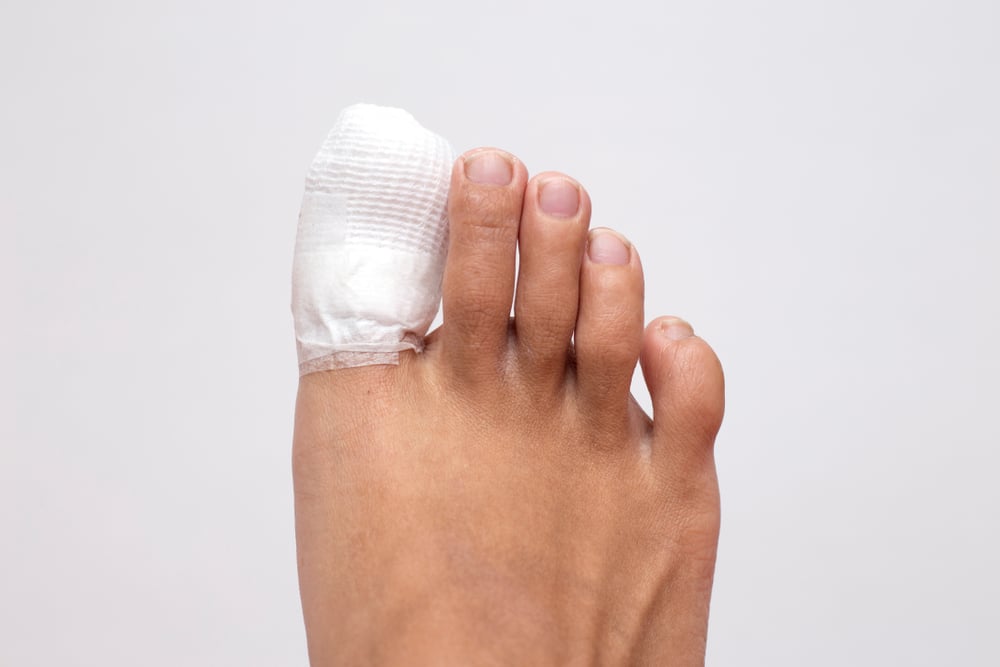
Toenail surgery is a minimally invasive procedure that is walk in / walk out. Follow your podiatrist's post-op care guidelines and you will be back to normal (pain free) activities in little time.

The prevention of nail regrowth stands as a critical component in surgical interventions for ingrown toenails, with phenolization representing the gold standard approach during matrixectomy procedures.

Under local anaesthetic, this chemical destruction of nail matrix tissue reduces recurrence rates to 1.1-4.3%.

Alternative surgery options include electrosurgical ablation and laser matrixectomy, offering similar efficacy in preventing regrowth.

The only very mild and short discomfort you will feel is the light pin prick of the syringe. After two seconds of discomfort, the pain killer works fast and you feel no further pain or discomfort during the procedure.

Post-Procedure Care and Recovery

Following ingrown toenail removal, you’ll need to prioritise proper wound care and activity modifications to promote effective healing outcomes:

Preventing Future Ingrown Toenails

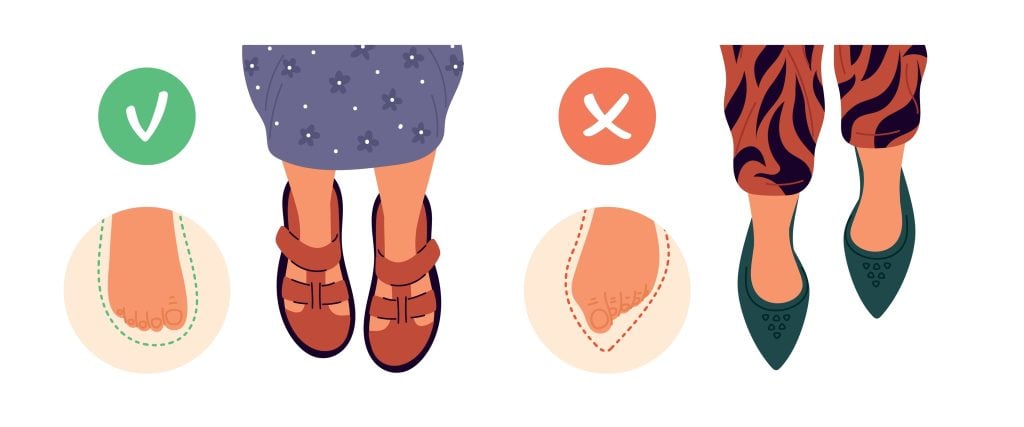
Wearing properly fitted shoes with a wide toe box and low (if any) heels is the ideal choice of footwear. An experienced podiatrist can review your footwear and guide you on the best possible choices. Get the right professional advice from those with specialised education and experience in the complex field of foot & ankle health.

Why should you invest time in prevention strategies when simple lifestyle modifications can significantly reduce your risk of developing future ingrown toenails?

Evidence-based prevention requires systematic implementation of proven techniques:

  • Proper nail trimming technique

    Cut toenails straight across using clean, sharp trimmers, avoiding rounded edges or cutting shorter than the toe tips to prevent inward curvature.

  • Appropriate footwear selection

    Choose shoes with wide toe boxes that provide adequate space, reducing pressure-induced nail ingrowth.

  • Optimal foot hygiene maintenance

    Keep feet clean and dry daily to minimise infection risks.

  • Trauma protection protocols

    Wear protective footwear during sports and manual activities to prevent repetitive injury-related ingrowth.

Cost and Coverage of "Removal of Ingrown Nails"

How much will you pay for ingrown nail removal, and what portion will your insurance cover?

Partial nail avulsion can cost between $200 – $400 without insurance, while total nail avulsion can cost around $400 – $600, including anaesthesia and consultation fees.

Extras insurance cover typically covers medically necessary procedures involving infection or significant pain, though pre-authorisation may be required.

Private insurance plans can cover non-cosmetic removal, with out-of-pocket costs ranging from $50 to $200 depending on your plan – you will need to specifically confirm with your insurance provider as it is different depending on who you are with and what level of private health insurance cover you have.

When to Seek Professional Help

Don't let foot pain hold you back. Get the treatment you deserve so you can get back to doing the things you love.

When should you escalate from home care to professional medical intervention for an ingrown toenail?

You’ll need immediate professional intervention when conservative measures fail or complications arise: Seek immediate medical care when home treatments fail to improve your ingrown toenail or when complications develop.

Chronic recurrent cases warrant specialist consultation for definitive surgical management.

Summing It All Up...

Managing ingrown toenails effectively requires a combination of proper self-care techniques and professional intervention when necessary. From conservative approaches like warm water soaks and antibiotic ointment application to surgical procedures such as partial nail avulsion with phenolization, multiple treatment options exist to address this common podiatric condition

Don’t let ingrown toenails compromise your mobility and quality of life—schedule a consultation with Bellevue Podiatry today for an expert evaluation and personalised treatment solutions that will get you back on your feet comfortably.

If you think you may have an ingrown toenail and want the right professional advice on how to treat it, we currently have a limited offer running to help you out. A GAP FREE ingrown toenail assessment consult (only $69 for those without extras private insurance).

Please feel free to book yourself in online or call our friendly Reception on (03) 8104 9270 today.

Ingrown Toe Infection

Understand how you get ingrown toenails your self care home options and what you can do to get rid of them once and for all. You don't need to put up with the pain of an ingrown toenail any longer.

podiatry care
Picture of Bellevue Podiatry Treatment Clinic

Bellevue Podiatry Treatment Clinic

Bellevue Podiatry has been serving the people of Rosanna and its surrounding suburbs for over 10 years. We have the qualifications, experience and education to effectively treat any lower limb condition or injury that requires expert podiatry care.

Picture of Nicole Hardidge - Principal Podiatrist

Nicole Hardidge - Principal Podiatrist

Nicole graduated with a Bachelor of Podiatry from Latrobe University in 2009 with a certificate in Advanced Clinical Education. Nicole has completed her post graduate certificate in wound care through Monash University.

If you would like a deeper understanding of the content discussed in this article, please click on the links below:

  1. https://www.mayoclinic.org/diseases-conditions/ingrown-toenails/symptoms-causes/syc-20355903 (Mayo Clinic)
  2. https://www.health.harvard.edu/a_to_z/ingrown-toenail-a-to-z (Harvard Health Publishing)
  3. https://pubmed.ncbi.nlm.nih.gov/29589602/ (PubMed)